

Indie artist Nathan Oswalt hails from the Pacific Northwest, and his latest single, “whatever happened to US?,” certainly shows his roots. Featuring a folk/pop sound worthy of Jack Johnson, Oswalt’s new tune not only pulls from America’s musical history, it addresses the nation’s current history. As you might guess from the title, Oswalt is pondering the current state of affairs in the US. The song opens by highlighting all the divisions found in the States, leaving Oswalt wondering what went wrong. The repeated refrain is simple: “Whatever happened/To one nation, under God?” In the second verse, Oswalt tries to give advice, encouraging responses that are slow to anger and that build each other up. He ultimately sees that if change will happen, it must happen on the individual level with everyday people.
Released in time for America’s 250th birthday, “whatever happened to US?” is Nathan Oswalt’s way of urging Americans to turn to (what many call) the nation’s “Christian roots,” and be a people of love and faith. Some Christians might argue with the idea of America being a Christian nation (and what expectations can thus be put on its citizens), but no matter where you stand on that issue, you can agree that the country would be a better place if we all strove for unity instead of division. We should want “liberty and justice for all,” and as believers, we should understand that such values should be a part of us whether we are American or not. On the whole, Oswalt shows good development in his artistic growth. The music is catchy and the lyrics flow well alongside it. If you are putting together a CCM-inspired patriotic playlist, “whatever happened to US?” should be included in the mix.
While the imagery used in the album art and some of the lyrics may seem to express Americanism or Christian Nationalism, that’s not where this track is coming from. Nathan Oswalt’s approach here is more of heartbreak at the current state of affairs. He expresses a desire for God to be the center of our lives again and urges followers of Christ to lead the way in spreading the change. The lyrics don’t express any political agenda, but instead a spiritual agenda. Nathan Oswalt continues to be a songwriter that impresses me and “whatever happened to US?” is no exception. I’d encourage you to listen to this one over the holiday and pray about how God wants you to be the change for others.
– Review date: 6/30/26, written by Michael Weaver of Jesusfreakhideout.com
 Record Label: None
Album length: 1 track: 3 minutes, 0 seconds
Street Date: May 15, 2026
Buy It: Amazon Music
Record Label: None
Album length: 1 track: 3 minutes, 0 seconds
Street Date: May 15, 2026
Buy It: Amazon Music

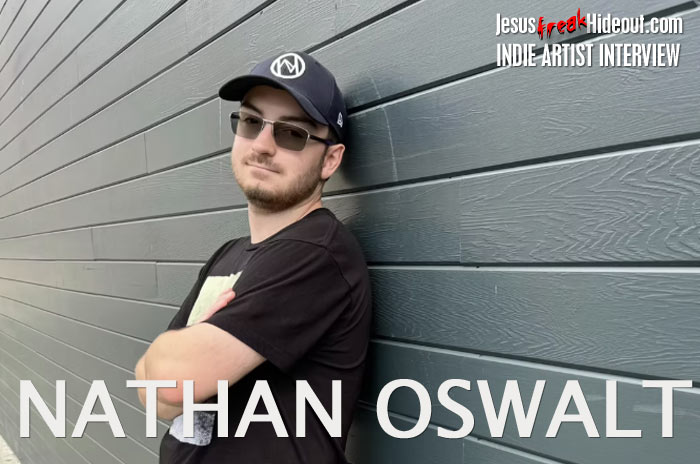
Nathan Oswalt: Music has always been a significant part of my life. Growing up in Vancouver, WA (where I still call home), I grew up on a steady diet of Christian music, both on the radio and on physical CDs (I still collect CDs to this day – sorry vinyl). I started seriously writing my own songs at around age 14 (largely as a means of both creative expression and thought-processing as an autistic person), and my parents helped me set up my own at-home recording studio shortly after I graduated from high school in 2019. I consider 2019 as the year I officially became an “active” artist; however, I didn’t release my first studio-recorded song until 2023, and I didn’t start performing live for my own artistry until just last year (I did have previous live experience from serving on several different worship teams as a guitarist).
On a more personal note, I’ve struggled with chronic depression and anxiety for most of my life, highlighted by a particularly difficult stretch from April 2022 to July 2023 during which I survived two severe suicidal episodes of depression (the second of which went down just weeks after my second song, “STILL GOOD,” dropped). After this, my faith in God deepened significantly, evolving into a more personal relationship with Jesus as opposed to accepting Christianity more from a “head knowledge” standpoint. Being able to better internalize that His work on the Cross was, is, and always will be enough for me has been nothing short of liberating, refreshing, and ultimately life-giving. For this reason, “Jesus Saved My Life” has become the official slogan for my music, as well as the super-shortened, one-sentence summary of my general life story. Though my lyrics aren’t always overtly “Christianese” (especially recently, as my songwriting skills have continued to grow and expand beyond just explicitly Christian music), there’s always a Biblical worldview behind every single line. I hope to encourage and challenge people, especially those who are going through similar things to what I endured, that the love of Christ and the truth of the Gospel are stronger than every mistake they’ve ever made and every lie they’ve ever believed.
Nathan: It depends on what sound best fits the song. For “MAKE UP YOUR MIND,” I definitely felt that more of an electronic, R&B-pop sound (similar to Charlie Puth or Lauv) was appropriate, especially given the track’s message of approaching modern dating/relationships with intentionality, focus, commitment, and clarity on what (and/or who) you want to pursue. For “whatever happened to US?,” I immediately knew that a more organic, folk-pop sonic structure (in the style of, say, Andy Grammer or Ed Sheeran) was going to be the best route. Given how often I experiment around with different sounds and genres, I think the most accurate description of my style of music is most definitely pop/alternative/indie.
Nathan: There was plenty of trepidation, for sure. I initially started writing the song in 2022 (it was titled “One Nation” at the time; my now-former Guitar Center instructor and good friend Elan came up with the new title), but I wavered on whether or not to record and release it. My immediate family (who serve as my de-facto management team) and I were concerned that taking my music in any sort of political direction would negatively impact my chances of reaching wider audiences and having any sort of positive influence on potential listeners. That’s part of why I’m so frustrated with the current sociopolitical climate in the United States – it’s so hard to say anything that even remotely references America, even in a non-partisan, apolitical manner, without potentially triggering someone or being wrongfully “canceled”.
I address that frustration in the lyrics – in particular, the line “Why do we keep on holding on to the wrongs of yesterday?” is a reference to cancel culture, especially in cases where people have been criticized or vilified for something wrong or stupid that they did or said – even from YEARS ago – that they have since grown past and moved on from. That doesn’t mean that we shouldn’t ever call people out when they do egregiously mess up, but it does mean that when we do so, we must correct them from a place of love – helping them grow and learn from their mistakes for their own sake, rather than just tearing them down for self-serving reasons. Jesus said it best in Matthew 7:3-5 (NIV): we can’t properly help those around us to remove a speck of sawdust stuck in their eyes without first checking for specks (or even planks) lodged in our own!
Anyway, back to what ultimately drove me to record and release the song… wanting to do something fun to celebrate the 250th anniversary of American independence was definitely a factor, but the assassination of Charlie Kirk was the final straw. I knew, in the immediate aftermath, that I had to “pick up the mic” and stand up against the rising tide of violence fueled by sociopolitical division and hatred.
I didn’t agree with Charlie (or his organization, Turning Point USA) on everything, but I always admired him for (1) his courageous commitment to promoting civil discourse and respectful debate, (2) his intentional willingness to seek out honest, good-faith conversations with those who disagreed with him, and most important of all, (3) his deep-seated devotion to sharing the Gospel through politics. Charlie’s love for Jesus was the one thing that exceeded his passion for America – indeed, it was his strong faith and his knowledge of Scripture that largely informed his conservative views – and I definitely observed a positive shift in the last few years of his life towards prioritizing eternal, spiritual matters over temporal political topics. I look forward to meeting Charlie in Heaven someday. In the meantime, I continue to pray for his widowed wife, Erika, as well as for his young children, the rest of his family, and his friends & coworkers – that God would continue to help them grow in their faith and ultimately use this terrible tragedy for His glory and their good. I also pray that the person who killed Charlie would ultimately come to repentance and saving faith in Jesus before the end, even though I do hope to see justice served. If Jesus can forgive those who nailed Him to the Cross, then I can follow His example by forgiving Charlie’s murderer (I still commend Erika for her astonishing grace and courage in doing just that at Charlie’s memorial service).
“whatever happened to US?” is dedicated to Charlie Kirk, and to carrying forward his message of pursuing civil discourse, respectful debate, relational reconciliation, and national restoration – all while speaking truth, doing so in love, and ultimately, advancing the Gospel.
Nathan: Nothing super specific – remember, I first started writing “whatever happened to US?” in 2022 – I just felt generally exhausted of, frustrated with, and disheartened by the seemingly constant sociopolitical division in the U.S. We’ve lost the art of firmly disagreeing with each other on certain issues while still treating each other with kindness and respect – and both sides of the aisle bear some of the blame. It’s not just “woke Lefties” or “MAGA right-wingers” – everybody who calls the United States of America their home has room to improve here. With the tensions recently escalating into violence, and with tragic casualties on both sides (examples: Charlie Kirk’s assassination; the fatal shootings of Renee Good and Alex Pretti in Minneapolis; the 3 assassination attempts on President Trump – not to mention the 2020 BLM riots and the initially-peaceful protest on January 6 that quickly went south), I am growing increasingly convinced that the future of our nation depends on it. America’s 16th President, Abraham Lincoln, famously said, “A house divided against itself cannot stand”. Those words still ring true today – which makes even more sense considering that Lincoln, who came to faith in Christ later in his life, was paraphrasing the words of Jesus Himself (as found in Mark 3:24-25)!
The whole message of “whatever happened to US?” is basically a different kind of protest song. Even though I lean conservative myself, I wanted this song to be as politically neutral as possible, so that anyone can relate to it. I wrote it in the hopes of encouraging and challenging people of all kinds from all across America to come together, to talk through their differences with kindness and dignity, and to recognize that we have more in common than we realize. Every one of us is made in God’s image, and we are all so valuable to Him that He gave His only Son to bridge the gap between His perfection and our imperfection. Ultimately, the Gospel is the answer to every question and the solution to every problem, not just in the U.S., but throughout this broken world.
To anyone currently reading this interview: no matter where you are on the sociopolitical (or even religious) spectrum, if you call the United States of America your home, then “whatever happened to US?” is for you.
Nathan: I am a massive history buff, especially of U.S. history, so this is a topic that I am deeply passionate about…
The whole idea behind the foundation of the United States of America is that human rights come from God, not from any worldly government. It’s also worth noting that the vast majority of the Founding Fathers were devout Christians, and all of them held a great amount of respect for the moral and practical teachings of Scripture.
One of the most significant critiques of the “Christian nation” argument is that the Founders were slave owners. However, I believe that the majority of them recognized that slavery would ultimately prove incompatible with their vision – one that clearly stated in the Declaration of Independence that “all men [general term for humankind] are created equal”. America was founded DURING a time of systemic racism – NOT ON systemic racism – and while some unfortunate compromises were made during the country’s early years, the decision of the Founders to allow amendments to be made to the Constitution over time if needed ultimately paved the way for the END of slavery in the U.S. Moreover, many abolitionists were sincere Christians who not only recognized the evils of slavery, but spoke up and fought valiantly – some, eventually, even literally, during the Civil War – to bring about freedom and equality for black people in America. We went on to survive the Jim Crow era, and during the Civil Rights movement of the 1960s, took even further steps in eradicating systemic racism from the U.S. Right now, it breaks my heart to see so many years of positive progress needlessly threatening to come unraveled, largely due to poisonous ideologies coming from both sides – extreme white supremacy on the Right (which I have observed to be much less common than normally depicted by mainstream news & media outlets), and Critical Race Theory on the Left (which has sadly broken into the mainstream as a largely embraced revisionist worldview that even some genuine Christ-followers have fallen for).
The United States has never been perfect. No country this side of Heaven is, and the Kingdom of God is where all Christians should be placing their ultimate allegiance, as Heaven is our true home. But it’s still one of the greatest worldly nations – if not the greatest worldly nation – in history. I am a follower of Jesus, first and foremost, but I am an American second, and I am deeply grateful for my country, for the basic freedoms that so many people in other countries lack, for the timeless, Biblically inspired values on which it was first built, and for just how far we’ve come in 250 years. There’s nothing wrong with being both a follower of Jesus and an American patriot; just be careful to keep Him first.
Nathan: After several unexpected delays, pushbacks, and lengthy efforts to get all my questions about pursuing a degree answered, I’m finally starting that up in the fall (barring anything else popping up). I’m returning to online classes at Grand Canyon University after a lengthy hiatus (I took most of my general education classes using the online program during the COVID-19 pandemic) to pursue, specifically, a Bachelor of Arts degree in Commercial Music. I’m excited to learn some more of the finer details about music production, engineering, composition, and business.
As for future releases… I’m planning on launching a Kickstarter to help fund my first (non-compilation) E.P. next year. I have one compilation E.P. of some of my early single releases (titled THE PRELUDE) already floating around on streaming platforms, but this upcoming project will be my first E.P. to be 100% comprised of brand-new original songs. I’m working on finishing up the lyrics and producing the demos in Logic Pro as we speak. Please be praying for me to stay motivated and committed to this endeavor during difficult or slow seasons of the creative process, and more importantly, to never lose sight of just what (and Who) I’m ultimately doing this whole music thing for.
Nathan: The best way for people to connect with me is to follow me on Instagram, subscribe to my YouTube channel, and/or follow my artist profile(s) on Spotify, Apple Music, and Amazon Music. Right now, I’m trying to build a larger following, so the best way for people to help me in this way is to (and all-caps for emphasis) SHARE MY MUSIC & VIDEO CONTENT with anyone and everyone they know who might enjoy it or be positively impacted by it in some way.
Additionally, as I mentioned earlier, I have plans to set up a Kickstarter campaign for a larger project at some point next year. I’ll let people know on Instagram & YouTube (the only two social media platforms I use) as soon as it’s ready, so stay tuned on that front!
Nathan: That’s easy. I’ve heard way too many horror stories about people losing fingers to fireworks accidents to have any desire to personally set one off myself. I recently went on a ferris wheel for the first time in my life while at Disneyland, so even though I’m mildly scared of heights, I’ll take the ferris wheel over the frontlines any Independence Day. I’d also probably wear headphones, as fireworks can be very loud and I don’t want to risk any damage to my hearing (especially as an aspiring music artist).